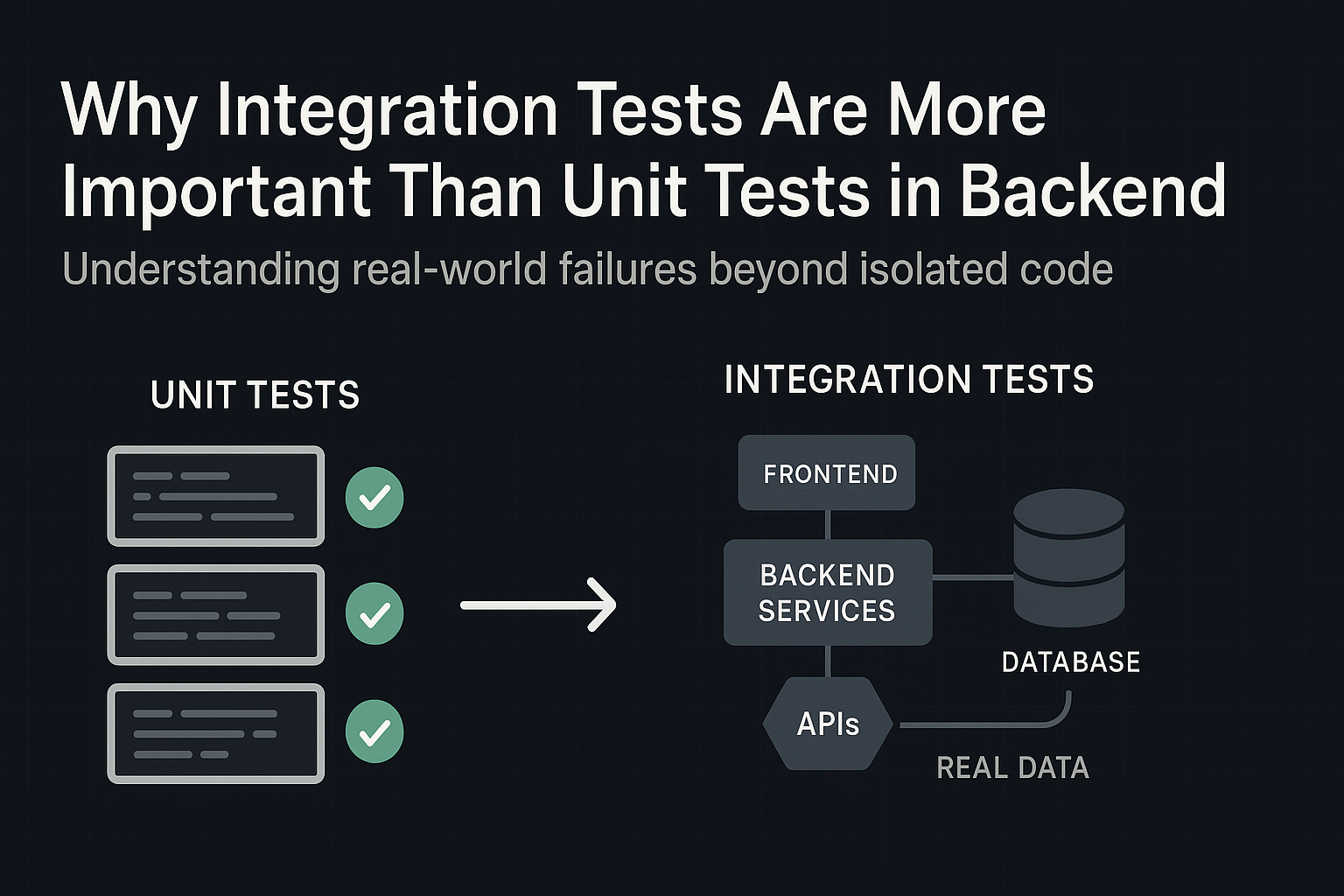
You do unit tests. That’s good.
You write functions in isolation. You mock DBs, APIs. You test logic paths. You catch bugs early.
But sooner or later you’ll notice something weird.
The code works in dev. It passes 90‐100% unit test coverage.
Then in staging or production some weird bug shows up. A module returns wrong data. Two services don’t talk properly. The system breaks when real data flows through.
That’s because unit tests only cover parts, not paths. They don’t test whether your modules or services actually work together. That is where integration tests show their real power.
Stuff Unit Tests Miss (That Integration Tests Don’t)
Integration tests look at the big picture. They test how your system behaves when everything connects and runs for real.
Here’s what they catch that unit tests usually don’t:
Modules actually communicating
Not just mocked calls. Does service A really talk to service B?Real DB queries and schema issues
Not just “pretend this returns a user,” but what happens when the DB enforces a constraint?Third-party behavior
APIs fail. Networks glitch. Integration tests check what happens when the internet isn’t friendly.Actual data flow
From HTTP request all the way through services and back to the response.Messy edge cases across services
One service returns null, another crashes, something goes off-spec. Can your system handle that?
Why You Should Bother
Unit tests are cheap and fast, but they don’t catch real-world problems. Integration tests aren’t just a “nice to have.” They’re your insurance against surprises.
They test what really happens
Not idealized code, not happy paths, just reality, mess and all.They catch most real bugs
Those weird “but it worked locally” bugs? Integration tests would’ve flagged them.They make refactoring safer
You move some logic around, change an API, forget one tiny thing. Boom. Integration tests catch that.They reflect real environments
Your dev machine isn’t staging. Staging isn’t prod. Integration tests help surface those config differences and dependency mismatches before they bite.
But Yeah, Unit Tests Still Matter
Not trying to throw unit tests under the bus.
They’re fast. They’re great for logic-heavy stuff. They help you spot regressions early.
Use them to:
- Cover tricky logic or edge cases in a single function
- Get instant feedback while coding
- Lock down tiny pieces before stitching them together
Just don’t expect them to catch system-level issues. That’s not their job.
How to Add Integration Tests Without Hating Life
You don’t need 100% integration coverage. Start small. Target the important stuff.
Pick critical paths
Login flows, payments, key APIs, anything users (or revenue) depend on.Use real test DBs and sandboxed APIs
If you can avoid mocking, do. Fake stuff won’t warn you when reality breaks.Automate setup and teardown
Reset state between tests so they don’t bleed into each other.Keep tests focused
Small integration tests are better than massive “test everything” suites.Log everything
When a test fails, you should know why, not just “500 error happened.”Maintain them like actual code
If your app evolves, your tests should too. Otherwise, they’ll start failing for no good reason or worse, pass when they shouldn’t.
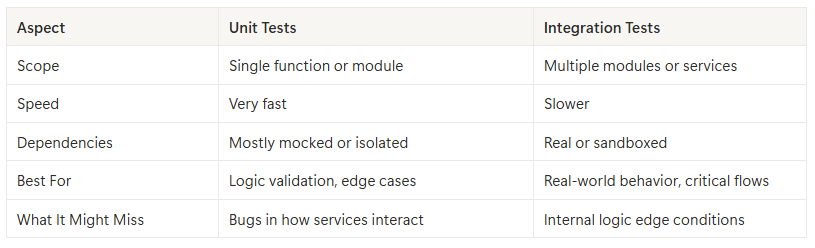
Unit vs Integration Tests (Quick and Dirty)
Final Thoughts
Here’s the thing:
Your unit tests might be perfect, but your backend might still be broken.
Integration tests don’t just test your code, they test your assumptions. They reveal how things behave when the whole system runs together, under pressure, with real-world messiness.
You don’t need to go all-in overnight. Just start with one important workflow. Add a test. Then another.
Eventually, you’ll sleep better, ship with more confidence, and stop seeing bugs that start with “but all the unit tests passed…”