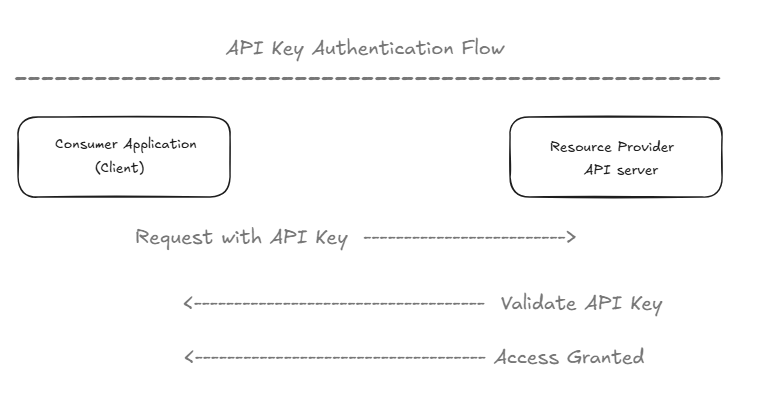
API keys are everywhere. They seem like the easiest way to secure backend communications
a simple token you hand out so clients can prove who they are. But that simplicity hides some serious risks. If your backend relies only on API keys to authenticate service-to-service calls, you might be opening yourself up to security problems and headaches that are not obvious right away.
In this post, we’ll take a closer look at why API keys, while very common, come with major drawbacks. Understanding these will help you design systems that are safer and more reliable.
What Are API Keys and Why Do People Use Them?
An API key is basically a static token that identifies a client application to an API server. When one backend talks to another, it sends this key, usually as part of the request headers or URL query parameters, to say “Hey, it’s me!”
Why are API keys so popular? The answer is simple: they are easy to create and use. You do not need complex setup or infrastructure. They work everywhere, from simple internal services to public APIs. Because they are just strings of characters, you can share them quickly between teams or systems.
But this simplicity comes with trade-offs. API keys are just a shared secret
a password for your system but unlike user passwords, they usually never expire and often come with broad access. That makes them risky if not handled properly.
Why API Keys Can Be Risky
1. They Live Forever Unless You Revoke Them
One of the biggest problems with API keys is that they do not have an expiration date. Once created, they stay valid until someone manually revokes them.
That means if a key gets leaked, stolen, or accidentally exposed, an attacker can keep using it indefinitely. Sometimes this can last for months or even years without raising suspicion.
This is very different from short-lived tokens that expire quickly and limit how long an attacker can do damage.
2. No Permission Control or Granular Scopes
API keys simply prove that the client has access. They do not say what the client is allowed to do.
If someone steals a key with wide permissions, they get full access to everything that key can reach.
This lack of granular permissions forces you to either give keys too much power or create many keys with overlapping scopes. Managing and auditing these keys then becomes difficult.
3. Rotating API Keys Is a Hassle
Because API keys often live in configuration files, environment variables, or sometimes even hardcoded in source code, updating or rotating them is not straightforward.
Changing a key means coordinating deployments across all clients and services that use it.
This complexity often leads to keys not being rotated as often as they should be, increasing the window of risk.
4. No Clear Identity or Audit Trail
An API key only proves possession. It does not tell you who is actually making the request.
This makes it hard to track down which user, team, or system performed a particular action.
If abuse or mistakes happen, your logs will not easily show the culprit. This makes debugging and accountability more difficult.
5. Secrets Stored Everywhere, Often Insecurely
Developers sometimes store API keys insecurely hardcoded in source code, saved in plaintext environment variables, or pushed accidentally to public repositories.
These practices increase the chances of accidental exposure.
Once exposed, keys can be exploited by anyone who finds them, often before anyone notices the leak.
What This Means for Your Backend Security
Here’s why these risks matter in real life:
- Persistent Danger: One leaked key can cause trouble for a long time, allowing attackers ongoing access.
- Wide Blast Radius: Keys with too many permissions put your entire system at risk if compromised.
- Blind Spots: Without proper monitoring and auditing, misuse might go unnoticed.
- Developer Overhead: Managing keys poorly slows down development, complicates deployments, and creates firefighting situations.
How to Protect Yourself: Best Practices for API Keys and Beyond
Use Stronger Authentication Methods
API keys are a starting point, but consider moving to stronger methods:
- OAuth 2.0 Client Credentials Flow: This lets services request short-lived access tokens with specific scopes that expire automatically. These tokens reduce risk if stolen.
- Mutual TLS (mTLS): Both client and server authenticate each other using certificates, providing stronger identity proof and encryption.
- JWT Tokens: JSON Web Tokens can include embedded permissions and expiry times, adding more control than static keys.
Manage Secrets Properly
Store your keys and secrets in dedicated secret management tools such as HashiCorp Vault, AWS Secrets Manager, or Azure Key Vault. These services allow you to:
- Control who can access secrets
- Rotate secrets automatically
- Audit usage to detect anomalies
Rotate Keys Regularly and Limit Their Permissions
Make rotation a regular part of your security practice, not something you do only after a breach. Assign keys only the minimum permissions they need. For example, if a service only needs read access to a database, do not give it write permissions.
Monitor and Audit API Key Usage
Set up logging and monitoring for how keys are used. Track where requests come from, how often they occur, and what actions are performed. Set alerts for unusual activity such as a sudden spike in usage or calls from unexpected IP addresses.
When Are API Keys Okay?
API keys are not inherently bad. They can work well for low-risk, read-only APIs or services inside trusted, private networks. In these cases, pairing API keys with IP whitelisting and good monitoring can provide reasonable security without too much complexity.
But for anything sensitive or critical, do not rely on API keys alone. They should be one part of a larger, layered security strategy.
Wrapping Up
API keys are a handy tool, but they come with hidden risks. Without careful management, those risks grow over time. Treat API keys like what they are: static secrets that need serious care.
Whenever you can, use modern authentication methods that support expiry, scopes, and identity verification. And if you must use API keys, make sure you rotate them regularly, limit what they can do, and keep a close eye on how they are being used.
Understanding the dark side of API keys is the first step to building stronger backend-to-backend security.