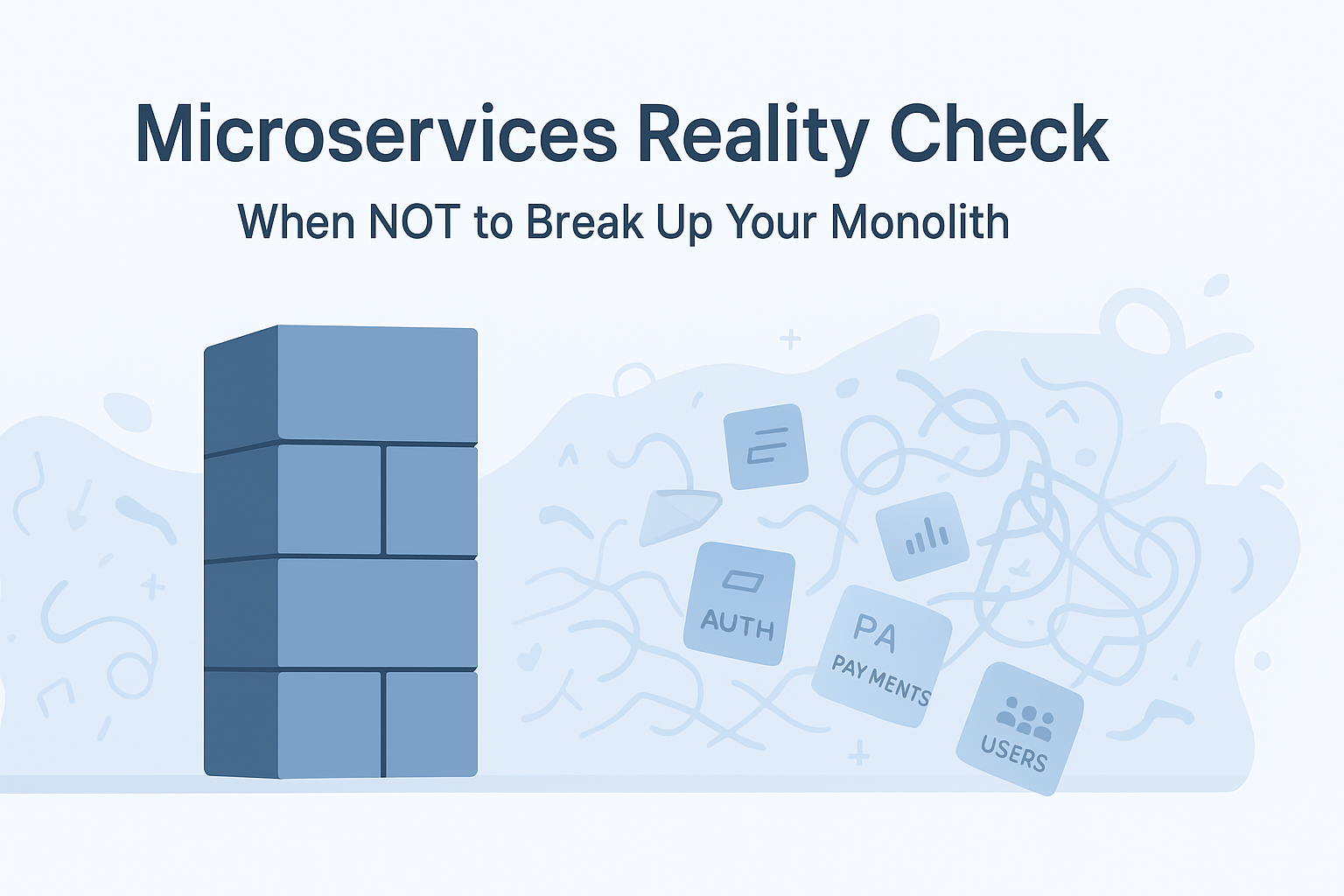
Breaking up your monolith feels like the cool thing. Everyone’s talking about services, APIs, scaling. But doing it too early or without real need causes more problems than it solves. This post will help you decide if you should hold off, what the risks are, and what to do instead.
Monolith vs Microservices: The Quick Scoop
- Monolith: One big happy codebase. UI, logic, database, all chilling together, no network nonsense. It’s like a cozy family movie night.
- Microservices: A squad of tiny services, each doing its own thing, chatting via APIs. More freedom, but also more chaos, like herding cats on a group call.
Monoliths aren’t evil. They’re simple, let you ship fast, and save you from distributed system headaches when your app’s still finding its groove.
Why Splitting Too Early Sucks
Jumping to microservices before you’re ready is like signing up for a 5K with zero prep:
- Overhead overload: More deployments, tools, monitoring, and API versioning. Your to-do list just got a second job.
- Slow APIs: In-process calls turn into network calls. Hello, latency and “network’s down” errors!
- Data drama: Monoliths love simple transactions. Microservices? You’re stuck with eventual consistency or sagas. Bugs incoming!
- Team chaos: Everyone’s gotta sync on API contracts and versions. Small team? Good luck dodging a communication meltdown.
- Weak infra?: If your CI/CD, logging, or monitoring is trash, microservices will make things fragile, not better.
When to Stick with Your Monolith
Keep the monolith if:
- Your app’s young and features shift like a viral dance trend.
- Your team’s small or hasn’t tangoed with distributed systems.
- Your deployment pipelines or monitoring are more “meh” than “miraculous.”
- You’re not hitting performance or scaling walls.
- Your database is one big, tightly knit crew.
What to Do Instead of a Breakup
Don’t ditch the monolith, make it better:
- Go modular: Split your code into clean, domain-based chunks inside the monolith.
- Level up tooling: Get solid logging, monitoring, and error tracing. Know what’s breaking before you break it more.
- Optimize the basics: Cache stuff, fix slow queries, untangle messy code.
- Test the waters: Extract one tiny, painful domain as a microservice. Don’t nuke the whole app.
Example of modularizing a Node.js monolith (just the vibe):
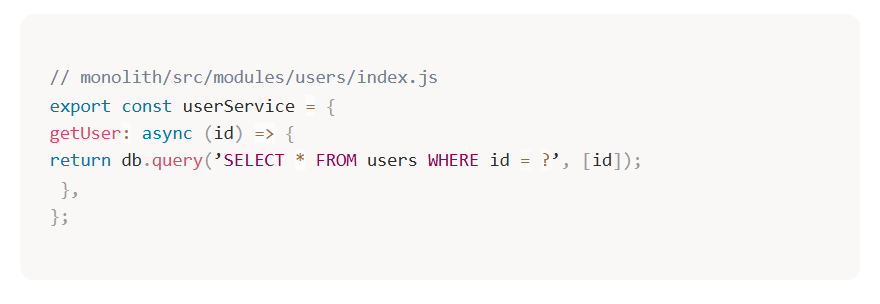
Keep domains separate, and you’re halfway to microservices without the drama.
When to Go Microservices
Split when:
- Part of your app’s choking on performance or scaling.
- Different chunks need wildly different resources.
- You’ve got multiple teams itching to own their own services.
- Your infra (CI/CD, monitoring) is rock solid.
- Data boundaries are crystal clear.
Real Talk: Microservices Aren’t Magic
Microservices swap one set of problems for another:
- Slower inter-service calls.
- More ways to crash and burn.
- Testing and debugging across services? Nightmare fuel.
- API versioning and compatibility headaches.
- More deployment and monitoring busywork.
The Bottom Line
Don’t shred your monolith just because microservices are the tech world’s latest obsession. Wait until your app, team, and infra are ready. Until then, keep your code modular, your monitoring tight, and your sanity intact. Monoliths are chill, treat them right, and they’ll have your back.